

Vibe Coding vs. AI SDLC: Where Do We Draw the Line?
The Prompt Every Developer Types (And Then Regrets)
There are two ways people build software with AI right now. One is to describe what you want in plain English and see what comes back. The other is to write requirements, design, and tests first, then bring the AI in at each stage.
Now here's the problem. You open a chat, type "build me a dashboard," and ten minutes later it's working. It feels incredible. So you keep going. Forty prompts later you have a feature that works, a codebase nobody has read, and a quiet suspicion that you couldn't explain how any of it fits together.
So you swing the other way: specs, design docs, test plans, review checklists, all for a script that renames files. Problem solved?
Not quite. You've traded one mistake for another. For most of us, that has been the tradeoff: vibe coding is fast but can't tell you it's correct. A structured process can tell you it's correct, but it isn't fast.
Neither is wrong. They suit different situations, and most confusion comes from using one where the other belongs.
But first, what vibe coding actually costs.
The Gamble We've All Shipped to Production
Vibe coding works like this: you describe a feature, the AI writes it, you run it, something breaks, you paste the error back, and you repeat until it works.
It's a gamble in the plain sense that you can't know the outcome of an iteration before you run it. Each prompt carries some uncertainty:
1. The fix may not be a fix. Sometimes the AI resolves one bug and introduces another somewhere else. The bug count stays the same, but it's now more interesting.
Picture the chat history: "make the login work," "now fix the error you just introduced," "no, the other error," "why is the signup page gone." Every developer has been there.
2. "Done" is subjective. With no written criteria, you stop when it looks right, which is a standard that has shipped many bugs.
3. Context fades. By prompt 40, the model has no memory of a decision from prompt 6, and the codebase starts to read like a group project where nobody met.
4. Unread code piles up. Each iteration builds on code you haven't fully reviewed, so small problems quietly accumulate.
None of that makes it a bad approach. When the cost of being wrong is low, it's fast and effective. A prototype, a one-off script, or an experiment to see if an idea holds up are all good fits.
There's also a hidden cost: speed feels like progress. Ten quick wins in a row can hide the fact that you now own code you couldn't explain in an interview or on a bad Monday.
Enter the AI SDLC: The Structured Path
An AI-driven software development lifecycle keeps the familiar stages and uses AI within each of them:
- Requirements: define what "done" means before generating anything.
- Design: choose the architecture, data models, and API contracts.
- Implementation: generate code in small, scoped pieces rather than one giant prompt.
- Testing: let tests, not impressions, decide whether it works.
- Review: a human reads the diff. Actually reads it. Skimming at speed doesn't count.
- Deploy and monitor: CI/CD, logging, and a rollback plan for when things go wrong.
It's less exciting than prompting and hoping, but it gives you something vibe coding can't: a way to know the result is correct.
Structure also has a quiet side benefit: when something does break, you have a spec, a test, and a diff to point at, so debugging feels like detective work instead of archaeology.
Two Ideas That Decide Everything
- Blast radius — how much breaks, and for whom, if this code is wrong. A throwaway script has a blast radius of one annoyed developer. A payments page has a blast radius of real money.
- Reviewability — whether a human can realistically check that it's right. Small, tested, documented code is reviewable. Forty prompts of unread output is not.
Small blast radius, low need for review: vibe away. Large blast radius, or code others must trust: that's where structure earns its keep.
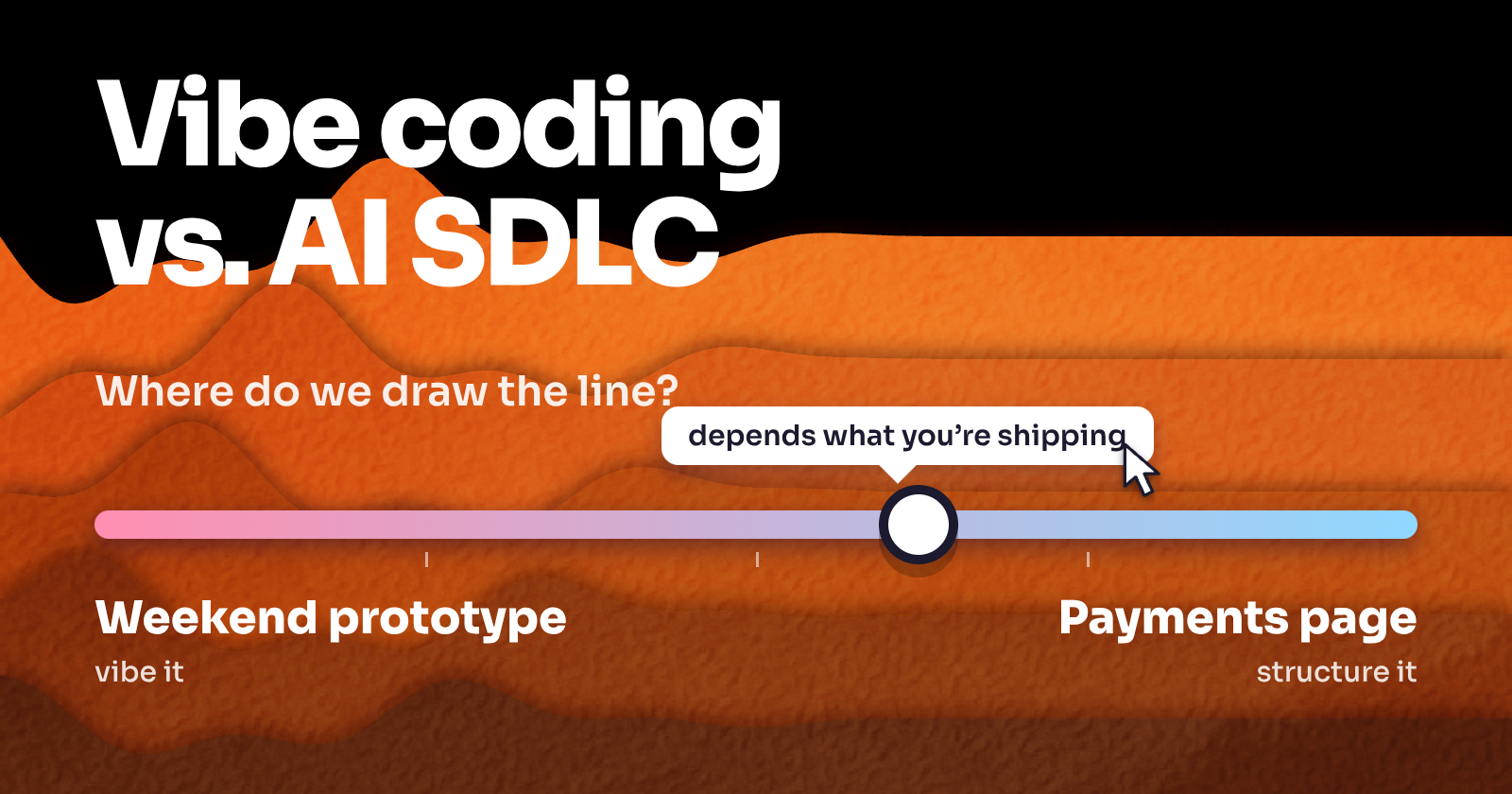
Where Do We Draw the Line?
The boundary isn't about the tool. It's about how costly a mistake would be.
| Question | Vibe it | Add structure |
|---|---|---|
| Will this live longer than a week? | No | Yes |
| Will other people maintain it? | No | Yes |
| Does it touch auth, payments, or user data? | No | Always |
| Can I delete it and start over without much pain? | Yes | No |
If a mistake is cheap, move fast. If it's expensive, add process. Code that handles someone's money deserves more than "it seemed to work."
A useful gut check: imagine explaining a failure to a user, a teammate, or your future self. The more uncomfortable that conversation sounds, the more structure the task deserves.
Vibe First, Then Harden
You don't have to pick one. A sequence works well:
- Vibe to explore. Sketch quickly and learn what you actually want.
- Write the spec. Once something works, document what it does and what it must never do.
- Rebuild with structure. Add tests, review the code, and clean up the architecture.
Call it a peace treaty: the sketch gets its freedom, the blueprint gets the final say.
Vibe coding is the napkin sketch. AI SDLC is the blueprint. Nobody builds a house from a napkin, but plenty of good houses started on one.
The Catch: Structure Isn't Free Either
This isn't a story where one side simply wins:
- Process can be overkill. Writing specs and test plans for a throwaway script wastes the very speed AI gives you.
- Structure can slow exploration. If you don't know what you want yet, writing a detailed spec first often just locks in a wrong guess.
- A prototype can quietly become production. The most common failure isn't vibe coding itself. It's the weekend experiment that nobody ever rewrote.
None of these are reasons to skip structure. They're reasons to pick it on purpose.
So, Which Side Should You Pick?
Honestly? Nobody has to lose. Vibe coding gets the weekend experiments, the AI SDLC gets anything with users, money, or teammates attached, and both keep their dignity. Just don't send a weekend experiment to production in a trench coat and hope nobody notices.
Closing Thought
Vibe coding isn't reckless, and AI SDLC isn't pointless ceremony. The real problem is a mismatch: putting an unreviewed prototype into production, or running a six-stage process for a script that renames files.
Know what's at stake, choose the mode that fits, and keep a human accountable for what ships. The AI writes quickly, but you're the one who gets the 2 a.m. alert.
Next time someone says "just vibe it" or "we need a full process for this," you've got a better answer than a shrug: it depends on the blast radius.
About the author
- Passionate Full Stack Developer currently focussing learning and sharpening skils on MERN & Node.js. Committed to excellence, continuous learning, and building functional solutions.
Comments
Join the discussionNo comments yet. Be the first to comment.


